
Most Salalah itineraries you’ll find online are written by people who spent a weekend here on a tour bus. This one is different — we’re a local car rental company, we drive these roads every day, and we’ve built this route around actual driving times, the order that avoids the crowds, and the stops that are worth your time.
Three days is the sweet spot. You can see the highlights in two, but you’d be rushing. Here’s how we’d do it.
Day 1: East Salalah — waterfalls, Wadi Darbat, and Jabal Samhan
Head east on Route 49 toward Taqah. The whole day loops through the most photographed corner of Dhofar, so start early — by 9 am the tour vans arrive.
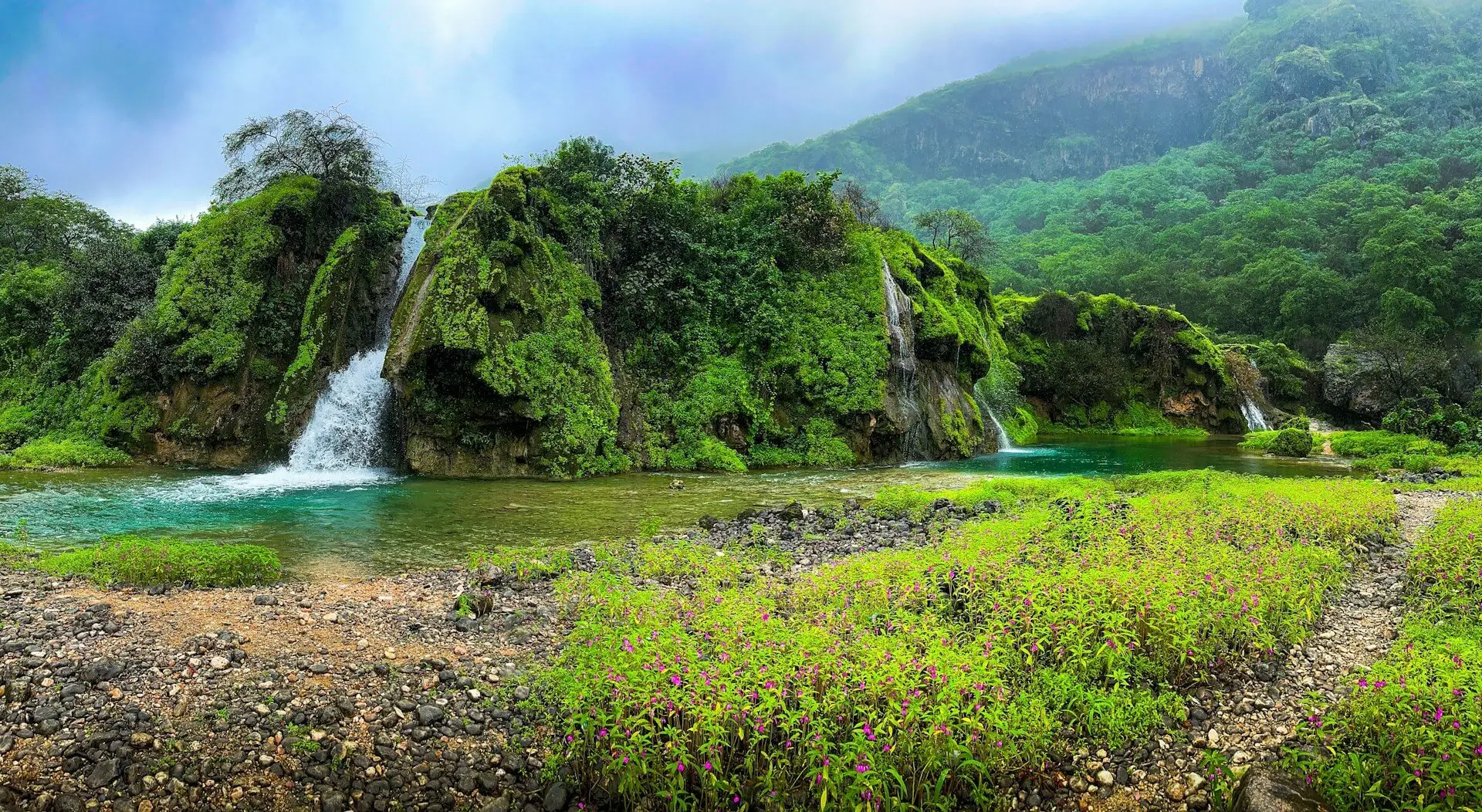
Ayn Athum and Ayn Tabraq (35 min from the city) are your first stops, two spring-fed waterfalls just off the road. In khareef season Ayn Athum is roaring; the rest of the year it’s a quieter trickle but the pools stay green.
Wadi Darbat (15 min further) needs no introduction — the lake, the camels, the valley walls. Rent a pedal boat if the water is high, or just walk the banks. Give it two hours minimum.
Tawi Atair sinkhole (20 min up the mountain) is a 200-meter-deep hole in the earth, one of the largest sinkholes in the world. The viewing platform takes ten minutes; the drive up is the real scenery.
For lunch, drop back down into Taqah for grilled fish, or hold out for Mirbat.
In the afternoon, drive up to the Jabal Samhan viewpoint (about 1 hour from Taqah). The road is fully paved and the cliff-edge view — 1,000 meters straight down to the coastal plain — is the single best panorama in southern Oman. On the way back, stop at the Anti-Gravity Point, put the car in neutral, and watch it appear to roll uphill.
Total driving today: about 3 hours. A sedan handles all of it, though the Samhan climb is more relaxed in an SUV.
Day 2: West Salalah — Mughsail, the hairpin road, and Fizayah Beach
Today is shorter on stops but bigger on drama. Head west along the coast on Route 47.
Mughsail Beach (40 min from the city) is a long ribbon of white sand backed by cliffs. At the western end, walk to the Al Marneef Cave blowholes — when the tide is right, seawater blasts up through the rock like a geyser. Time your visit for higher tide if you can.
Past Mughsail the road turns into one of the great drives of Arabia: a series of switchbacks climbing the cliff face toward the Yemeni border plateau. Near the top, a signed turnoff leads down to Fizayah Beach — a string of hidden coves beneath white cliffs where camels graze on the sand. This last stretch is a steep graded track, and it’s the one place on this itinerary where we genuinely recommend a 4×4 or SUV. In a sedan, park at the top and walk down; in a Fortuner or Armada, drive right onto the coves.
Fizayah is the kind of place you plan an hour for and stay three. Bring water and food — there’s nothing there, which is exactly the point.
Back in the city by late afternoon, wander Haffa Souq near the corniche for frankincense — Dhofar has produced the world’s finest for a few thousand years, and it costs a fraction of what you’d pay elsewhere.
Day 3: The city, the history, and the slow morning
After two days of driving, day three stays close.
Start at the Sultan Qaboos Mosque on the Salalah–Thumrait road (non-Muslim visitors welcome in the mornings, dress modestly). Then the Al Baleed Archaeological Park and Museum of the Frankincense Land — Al Baleed was the medieval port that shipped frankincense to the world, part of a UNESCO World Heritage Site, and the ruins sit right on the water.
Lunch at a local Dhofari restaurant — ask for majboos with camel meat if you’re feeling adventurous, or stick with the fish, which never misses.
In the afternoon, drive 15 minutes east to the coconut plantations along Al Dahariz — roadside stalls sell fresh coconuts, bananas, and papayas grown right behind the stall. It’s the most un-Arabian scene in Arabia. Finish with sunset on Al Dahariz Beach.
The practical bits
Getting around: there’s no way around it — this itinerary only works with your own car. The distances are long (day 1 alone covers 150+ km), there’s no public transport to any of these places, and hiring a taxi for three full days costs more than a week’s car rental. Our post on renting a car vs taxis and tours in Oman breaks down the numbers.
What car do you need? A sedan like the Toyota Corolla covers 90% of this itinerary. Add Fizayah’s beach track and you’ll want an SUV. All our cars come with 200 km/day included, which comfortably covers every day of this route.
When to come: khareef season (June–September) for the green mountains and waterfalls, October–March for warm sun, empty roads, and perfect beach weather. April and May are the quiet, hot months.
If you’re flying in, we’ll meet you at Salalah Airport with the keys — pickup and drop-off are free anywhere in the city. Message us on WhatsApp with your dates and we’ll sort the rest.


