
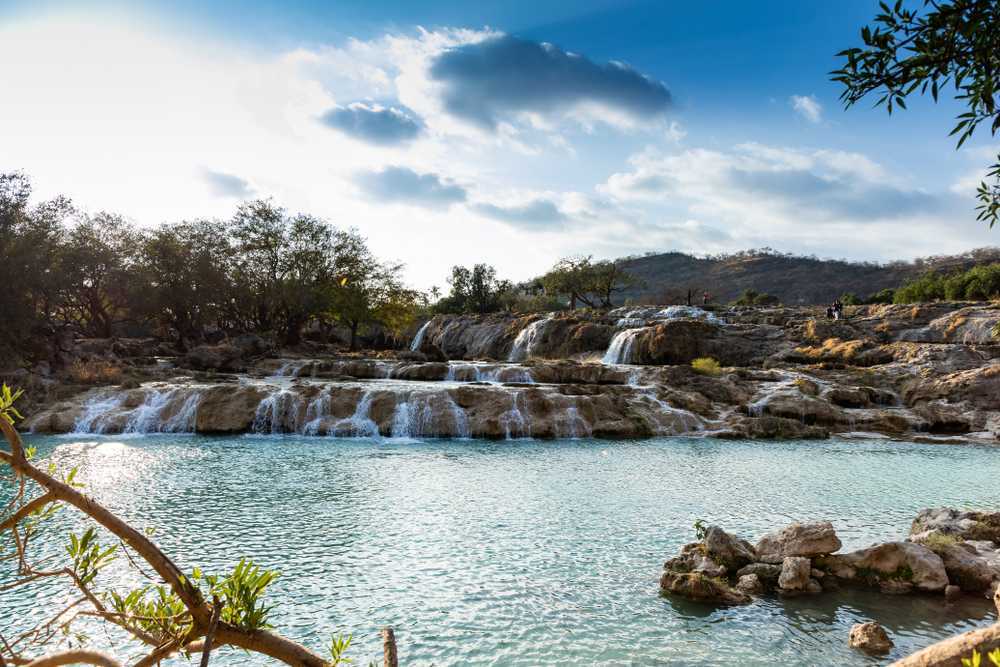
Every summer, something strange happens in the south of Oman. While the rest of the Gulf bakes at 45°C, Salalah cools down, clouds roll in from the Indian Ocean, and the brown mountains of Dhofar turn green. Waterfalls appear where there was dust a month earlier. It’s called the khareef, and it’s the only monsoon season anywhere on the Arabian Peninsula.
If you’re thinking about visiting this year, here’s everything you actually need to know — dates, weather, crowds, and how to make the most of it.
When is Khareef 2026?
The official season runs from 21 June to 21 September 2026. But the dates on paper don’t tell the full story.
The greenery builds gradually. Late June is misty but still patchy. By mid-July the hills are properly green, and from mid-July to mid-August the region is at its absolute peak — the strongest waterfalls, the thickest fog on the mountain roads, and the famous emerald landscape you’ve seen in photos. By early September the rain eases off, but the greenery lingers for a few more weeks and the crowds thin out considerably.
So if you want Salalah at its most dramatic, aim for July or August. If you’d rather have Wadi Darbat mostly to yourself, early-to-mid September is underrated.
What’s the weather actually like?
Cool, damp, and nothing like the rest of the Gulf. Daytime temperatures sit between 20°C and 27°C through the whole season. The rain is rarely heavy — it’s more of a constant fine drizzle, with fog and low cloud hanging over the mountains. Locals will tell you it feels more like Scotland or Kerala than Arabia.
Pack a light rain jacket, shoes with decent grip (viewpoints get slippery), and something warm for evenings in the mountains. You will not need the summer wardrobe you’d bring to Dubai or Muscat.
The Khareef Dhofar Festival
Khareef isn’t just about scenery. The 2026 season comes with a packed cultural program — over 125 events across the governorate, including traditional Dhofari music, the UNESCO-listed Al-Bar’ah dance, a frankincense and handicraft market, and food pavilions serving home-style Dhofari cooking. The main festival grounds get lively in the evenings from mid-July onward, and most of it is free to enter.
The spots you shouldn’t miss
Wadi Darbat — the headline act. A green valley with a lake, grazing camels, and seasonal waterfalls that only flow during khareef. Go early in the morning to beat the day-trip crowds.
Ayn Athum and Ayn Khor — two of the most reliable waterfalls in the region. Ayn Athum in the east is the bigger of the two; Ayn Khor in the west is quieter.
Mughsail Beach and the blowholes — dramatic cliffs west of the city where seawater erupts through holes in the rock. The drive along the coast to get there is a highlight in itself.
Jabal Samhan viewpoint — on a clear moment between fog banks, the view over the cliffs is one of the best in Oman. The drive up is winding but paved the whole way.
The Anti-Gravity Point — a stretch of road near Mirbat where your car appears to roll uphill in neutral. A gimmick, yes, but a fun one.
How to get around during khareef
Here’s the honest answer: you need a car. The attractions are scattered across a huge area — Wadi Darbat is 40 minutes east of the city, Mughsail is 40 minutes west, and Jabal Samhan is over an hour away. There’s no public transport connecting them, taxis for a full day of sightseeing get expensive fast, and organized tours lock you into someone else’s schedule — usually arriving at every waterfall at the same time as three other tour vans.
With your own car you can reach Wadi Darbat at 7 am before anyone else, wait out a fog bank with a karak tea instead of being rushed along, and stop at every unmarked viewpoint that catches your eye. We wrote a full comparison in our post on why renting a car in Oman beats taxis and tours.
A regular sedan handles the khareef roads fine — the main routes to Wadi Darbat, Mughsail, and Jabal Samhan are all paved. If you’re planning to explore rougher tracks or you simply want higher ground clearance in the wet, an SUV like the Nissan Rogue or a 7-seater Fortuner is worth the upgrade.
A few khareef driving tips from locals
Fog on the mountain roads can get thick, especially on the Ittin road and up toward Jabal Samhan. Slow down, use your low beams (not hazards), and give the car in front extra space. Watch for camels — they wander onto roads everywhere in Dhofar and they have absolute right of way, in both the legal and physical sense. And book your car early: khareef is peak season, and by mid-July the good vehicles across the city are gone.
Book your khareef car before the rush
We’re a local Salalah rental company, and every khareef we watch the same thing happen: visitors land in July and discover that every decent car in the city was reserved weeks ago. Our fleet starts from 12 OMR per day with 200 km/day included, free airport pickup and drop-off, and roadside assistance anywhere in Dhofar. Message us on WhatsApp and we’ll have a car waiting when you land.


